
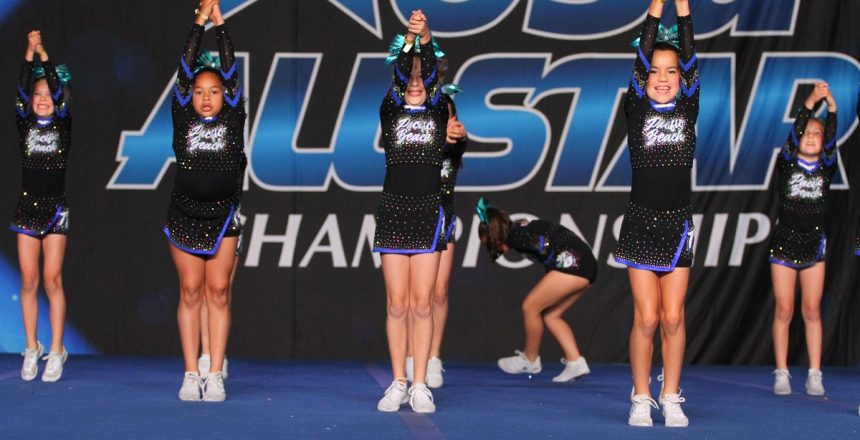
If your child loves to jump, tumble, and perform, cheerleading probably feels like a natural fit. The next question is harder: where should they do it? Many parents in San Diego find themselves comparing a school cheer team with an all star program, and the two can look similar from the sidelines. Underneath, they are quite different experiences.
This guide explains how all star cheerleading and school cheer differ, what each one offers, and how to decide which path fits your child’s goals, schedule, and personality.
What Is School Cheer?
School cheer is a team that represents a school, usually at the middle school or high school level. Squads are formed through tryouts and are coached by a staff member or a hired coach.
According to USA Cheer, school cheerleading involves crowd leading and other school roles, with the option to compete. In practice, that means school cheerleaders spend much of their time supporting other teams at football games, basketball games, pep rallies, and community events.
Typical features of school cheer include:
- Cheering at games and school events
- Building school spirit and leading the crowd
- A season tied to the school’s sports calendar
- A team made up of students from one school
- Optional competition, depending on the program
For many students, school cheer is a great way to be part of campus life, make friends, and represent their school.
What Is All Star Cheerleading?
All star cheerleading is a competitive sport. USA Cheer describes it as a discipline in which athletes perform a routine of about two and a half minutes that combines tumbling, stunting, pyramids, dance, and cheer. Its primary purpose is competition, rather than leading crowds at another sport’s events.
All star teams are usually based at a club or gym and are open to athletes from the surrounding area, regardless of which school they attend. Most all star clubs and competitions in the United States operate under the United States All Star Federation, known as USASF, which sets rules and credentials for athletes, coaches, and gyms.
So when you search for an all star cheer gym in San Diego, you are looking for a training facility where your child works toward competition routines, not game-day cheers.
The Key Differences at a Glance
Here is a simple side-by-side comparison.
Purpose
School cheer supports the school and its teams. All star cheer is built around competing as a team.
Where it happens
School cheer practices on campus. All star cheer trains at a dedicated gym with specialized equipment.
Who can join
School cheer is for students at that school. All star cheer is open to athletes from many schools.
Skill structure
All star teams are organized by levels, from beginner to advanced. The system includes seven levels, and each level allows a different set of skills. School teams may group athletes differently.
Time commitment
All star cheer usually involves regular practices at a gym and a season that includes competitions. School cheer follows the school’s sports and event schedule.
Focus
School cheer balances performance with spirit and community roles. All star cheer places more emphasis on technical skill progression, tumbling, and stunting.
Skill Development: Why Training Environment Matters
One of the biggest differences is how much time and structure goes into skill training.
All star gyms are built around the sport. They have spring floors, mats, and equipment designed for tumbling and stunting, along with coaches who focus on progression from one skill to the next. Athletes can move through levels at a pace that fits their development.
School programs can also build strong skills, but the training space and coaching resources vary from school to school. A gym environment gives athletes more consistent access to purpose-built facilities.
Tumbling is a good example. Many all star athletes also take separate tumbling classes in San Diego to build jumps, flips, and body control that translate directly to the competition floor. If your child is just starting out, tumbling classes can be a low-pressure way to build confidence before choosing a team.
Competition: A Central Part of All Star Cheer
In all star cheerleading, competition is the core of the season. Teams prepare a routine, attend events, and work toward performing at their best on the day that counts. The USASF level system and age divisions keep teams in appropriate categories so athletes compete against others of similar age and skill.
School cheer teams may compete as well, but many programs focus on game-day performance first. If your child is excited by the idea of preparing a routine, improving week by week, and sharing the stage with teammates, all star cheerleading can be a strong match.
Team Culture and Life Skills
Both options teach valuable lessons. Cheerleaders learn teamwork, discipline, time management, and how to perform under pressure. They also build confidence by working toward goals in front of an audience.
At a quality gym, coaches also focus on the whole athlete. Pacific Beach Allstars states that its mission is to create well-rounded athletes through integrity and skill, and it names strength, faith, family, and a love of the sport as its core values. When you evaluate any program, look for a culture that matches what you want for your child, not just a program that promises wins.
Can My Child Do Both?
Many families choose both. A child can cheer for their school during the fall and winter and train at an all star gym for competition. The combination can build skills, friendships, and experience in different settings.
The key is balance. Before you commit to both, look at your child’s schedule, homework load, rest time, and energy. A busy cheer calendar should still leave room for school, family, and fun.
How to Decide: Questions to Ask Your Child and Yourself
A few honest questions can point you in the right direction.
- Does my child want to compete, or mainly cheer on other teams?
- Is my child excited about tumbling and stunting skills?
- Does my child prefer being part of a school community or a club team?
- How much time can our family commit each week?
- Is our child a beginner who needs a gentle introduction or an experienced athlete ready for more challenge?
If your child dreams of competing and mastering skills, an all star program is worth a look. If they want to be part of campus life and lead the crowd, school cheer may fit better. If they want both, start with one and add the other once they are comfortable.
How to Choose the Best All Star Cheer Gym
Not every gym is the right fit, so visit before you decide. When you compare cheer gyms in San Diego, consider the following.
- Coaching. Look for experienced, supportive coaches who focus on safe technique and gradual progression.
- Facility. The training space should be clean, organized, and equipped for tumbling and stunting.
- Program options. A good gym offers several paths, such as recreational teams, competitive teams, and tumbling classes.
- Communication. Parents should receive clear information about schedules, expectations, and events.
- Culture. Watch how coaches speak to athletes and how teammates treat each other.
- Location and convenience. Searching for all star cheer gyms near me is a good start, but practice location and schedule should work for your family.
Visiting a practice or speaking with staff helps you decide whether the environment feels right.
All Star Cheer in San Diego at Pacific Beach Allstars
Pacific Beach Allstars was established in 2017 and offers programs including All Star Rec Cheer, Competitive Cheer, Tumbling, and teams for older athletes. The gym welcomes athletes who want to build skill and confidence in a supportive environment.
If you are exploring cheerleading classes in San Diego, you can learn more about the programs and locations at pacificbeachallstargyms.com. The site also includes a page about why choose cheer and information on school cheer, which can help you compare options.
Conclusion
All star cheerleading and school cheer both offer something special. School cheer builds spirit, community, and game-day energy. All star cheer focuses on training, skill progression, and competition in a dedicated gym setting.
The best choice depends on what excites your child and what works for your family. Think about goals, schedule, and personality, then visit programs and ask questions. When your child steps into a place where they feel supported and challenged, the right answer usually becomes clear. To explore programs and find a location, visit Pacific Beach Allstar Gyms.
Frequently Asked Questions
- What is the main difference between all star cheer and school cheer?
School cheer focuses on supporting school teams and events, with optional competition. All star cheer is a competitive sport built around performing a routine that combines tumbling, stunting, dance, and cheer. - Does my child need experience to join an all star cheer gym?
Not necessarily. Many gyms offer beginner and recreational options, and all star teams are organized by skill levels so athletes can start where they are comfortable. - Can my child do school cheer and all star cheer at the same time?
Yes. Many athletes do both. Check the schedules for each program and make sure your child still has time for school, rest, and family. - Do I have to attend a school to join an all star team?
No. All star teams are club-based and open to athletes from the surrounding area, regardless of the school they attend. - What should I look for in the best all star cheer gym?
Look for experienced coaches, a safe and well-equipped facility, a range of programs, clear communication, and a positive team culture. Visiting in person is the best way to see whether the environment fits your child.